1. Premiere Napa Valley is a great way to taste a lot of wine, but a terrible way to actually taste wine. Spending only 30 seconds with several hundred wines over the course of a few days is like trying to buy a house by only using Google Maps. You can get a broad understanding of the neighborhood and certain houses may catch your eye, but you don't get the real look and feel you would by spending time inside the houses to really explore them. You don't get to see how the wines taste with food or how they evolve over the course of an evening with friends and family. Pretty much you only get a general understanding, dehydrated, and terribly stained teeth.
2. Most of the wines I tasted during my three days in Napa were from the fabulous 2013 vintage, but some of the wines that stood out most to me were from the much less heralded 2011 vintage. Napa wine from 2011 ain't so bad, and may outshine the more critically acclaimed vintages down the road. Yes, 2011 was cool and wet, and many wines are defined by herbal, even moldy, greenness that most people will find off-putting. However, the wineries that were able to sort and use ripe (not overly ripe) grapes made some stunning wines. I heard one retailer joke that he was going to talk the 2011s up every chance he had just so others would be tricked into buying them so he wouldn't have to. I pity that fool. I look forward to tasting the few 2011 Napa cabs I have in my cellar more than any other vintage.

A website devoted to Colorado Wine and beyond.
Showing posts with label Vintage. Show all posts
Showing posts with label Vintage. Show all posts
Thursday, March 5, 2015

Wednesday, February 27, 2013
Six Further Thoughts on Premiere Napa Valley
I want to write about a few specific thoughts on Premiere Napa Valley in a bit more detail than my initial post.
1. Vintage matters. Tasting through a dozen producers' 2008, 2009 and 2010 cabernet sauvignon during the Vintage Perspective Tasting made this abundantly clear. After tasting 36 wines with only knowing the vintage, variety and that they were from Napa Valley, I concluded that 2008 is a great vintage. For almost every producer, I preferred the 2008 to the 2009 or 2010. Of the three vintages, 2008 had earliest bud break, a long, dry, hot growing season and the longest harvest period. Both 2009 and 2010 were cooler and wetter vintages. The 2008 wines were collectively the most complex and balanced wines in the room. The best offered a wonderful array of intense fruit, floral and earthy aromas and flavors complemented by smooth tannins. Wines from 2009 were a bit more varied in quality, and were generally lighter and with more floral characteristics. A few were unfortunately under-ripe, and the acidity was quite noticeable. The even cooler, shorter and wetter 2010 season was quite apparent in the wines as well. Most 2010s were marred with green tobacco aromas and rough tannins. Despite being greener, the 2010s still managed a bit bigger structure than the 2009s and few that achieved ripeness approached the 2008s in quality. The auction wines were mostly from the 2011 vintage which was even shorter, cooler and wetter than 2010. I think the detailed selection process that went into these unique wines may have provided a skewed view into the vintage as a whole, but many were thin and green. Others that managed to achieve proper ripeness were stellar, but many still were lacking much depth and hidden by massive tannins. For my favorites, see Tuesday's post.
2. Location matters. With the Premiere lot wines being mostly from the difficult, cool 2011 vintage, vineyard location was quite important. For me, wines from hills above the valley floor fared the best. The extra sun and lack of fog proved to be beneficial in this challenging year. From the variety of hillside locations, wines from Pritchard Hill were among the best. Both the Continuum and BRAND 2011s were two of my favorite wines the entire weekend. Other wines with Pritchard Hill grapes (Chappellet, Gandona, Krupp Brothers, Larkin, Montagna, Moone-Tsai and Purlieu) were nearly as wonderful. Howell Mountain (O'Shaughnessy and Derenoncourt California) and the hillside vineyards just south of Pritchard Hill (Oakville East Exposure) also yielded some of the better wines. Superior benchland sites on the west side of the valley (Vine Hill Ranch in Oakville and Corison's Kronos Vineyard in St. Helena) also made some exceptional wine. The best locations proved to make the best wines. Not really surprising when you think about it.
3. Winemaker matters. So many vintners will say that wine is made in the vineyard, but a masterful winemaker can really take great grapes and make exceptional wine. Bidders at the auction really were focused on name recognition. Philippe Melka had his name attached to more lots than any other winemaker and combined his 55 cases sold for $225,000, or just over $340 per bottle on average (Gandona at $28k, Vineyard 29 at $27k, BRAND at $26k, Gemstone at $26k, Roy Estate at $24k, Cliff Lede at $20k, Adamvs at $20k, Lail at $19K, Entre Nous at $18k and Moone-Tsai at $17k). I guess that is why he is the hottest name in California winemaking right now. Not only was name recognition important, but perhaps the most elegant, and my personal favorite, lot was made by a winemaker that is known doing more with cool vintages. Cathy Corison makes what many call a throwback style of Napa cabernet due to her lower alcohol, gentle extraction and delicate use of oak. While her wines are almost always very good, her wines' finesse and elegance are at their peak in challenging vintages such as 2011. I was wish I had an extra $15,000 laying around so I could have outbid the Houston company that was successful with a mere $14,000 bid.
4. The new kid on the block is ready to play ball. Thumbing through the catalog I was surprised to see so many wines list Coombsville AVA as a source for their grapes. I quickly counted at least 16 different wines with Coombsville fruit. That's pretty amazing given that Coombsville has only been an AVA for only about a year. Fruit from this small region just east of the town of Napa has been going into big name wines for years, but now this area is ready to take its rightful place as one of the premier districts in California. One of my favorite wines, though not an auction wine, was the interestingly named Inherit the Sheep. I'll definitely be looking into adding some of that to my cellar. Key an eye out for labels with Coombsville on them. Oh, and I much prefer the name Coombsville to the original name of Tulocay AVA; it just rolls of the tongue much more easily.
5. Cabernet Sauvignon may be King, but... Franc is the Knight in Shining Armor and a few other varieties excel in Napa. Many of the wines that I found most appealing had a heavy dose of cabernet franc. I think 100% cabernet sauvignon is often boring and greatly benefits from some blending with other varieties. BRAND (~50% cab franc) and Continuum (~30% cab franc) provide powerful evidence that more cab franc in the blend is a good thing. Oakville East Exposure's and Detert's 100% cabernet francs were also some of the standouts. And in a bit of a twist, O'Shaughnessy's 100% petit verdot was killer juice. Very rarely do you see varietal wines from petit verdot. Maybe next year they'll make a varietal St. Macaire! There were also a few random white wines in the lineup and Arietta's blend of 65% semillon and 35% sauvignon blanc stood out as a refreshing alternative to all the massive cabernet sauvignon based wines.
6. Winemakers and winery owners are real people. Sure, they may be rock stars in this little industry, but they are people just like you and me. They watched anxiously as people tasted their wines and were sincerely gracious when complemented on their product. I stood in the back of the room for much of the auction watching nervous vintners anxiously hold their breath when their wines were up for sale only to let out a sigh of relief when the bidding was over. I sat next to Tim Mondavi for about an hour and we chatted like he didn't have one of the biggest names in the wine world. At no time did I feel like the peon I am in the wine world. Sure, there is a lot of money and big egos in Napa, but isn't there everywhere? Most of the vintners I met were real, sincere people like you and I (except for you, and you know who you are...). I am already looking forward to next year (assuming I'm invited back) and working on convincing my wife to accompany me.
Wednesday, September 28, 2011
Ben's Bubbly: 2008 Gratien & Meyer Saumur Brut Rosé Premium Millésimé
The weather in Denver has been quite warm of late, and there is nothing worse than getting a cold in the summer heat. Well, I guess it is now early autumn heat. Unfortunately, I passed my congestion and cough on to Ben and he's been quite a trooper with his first cold. Even though his stuffy little nose sounded like an angry bear as he tossed and turned at night, but he was his usual bubbly self when he woke up. He isn't a big fan of us trying to wipe his nose, but he put up with us trying to keep his face clean. We're wiping his face more frequently now that we've started feeding him solid foods. First up this past week were bananas. He was not impressed with his first taste of the milk and banana mixture, but by the second attempt later that day he seemed to enjoy his new delicacy. Next week we'll add rice cereal to his menu.
 2008 Gratien & Meyer Saumur Brut Rosé Premium Millésimé
To escape the Denver heat, we enjoyed this pink French sparkler from the Loire Valley. This blend of 80% cabernet franc and 20% grolleau is extremely bubbly. It has been the only sparkler to foam out of the bottle when I've pulled the cork over the past six months. The wine is a beautiful shell pink color. I found strawberries, cranberries and flowers on the nose. Tart red fruit and bright acidity fill the mouth and it almost tastes like a very floral perfume.12% abv Purchased $17 Good
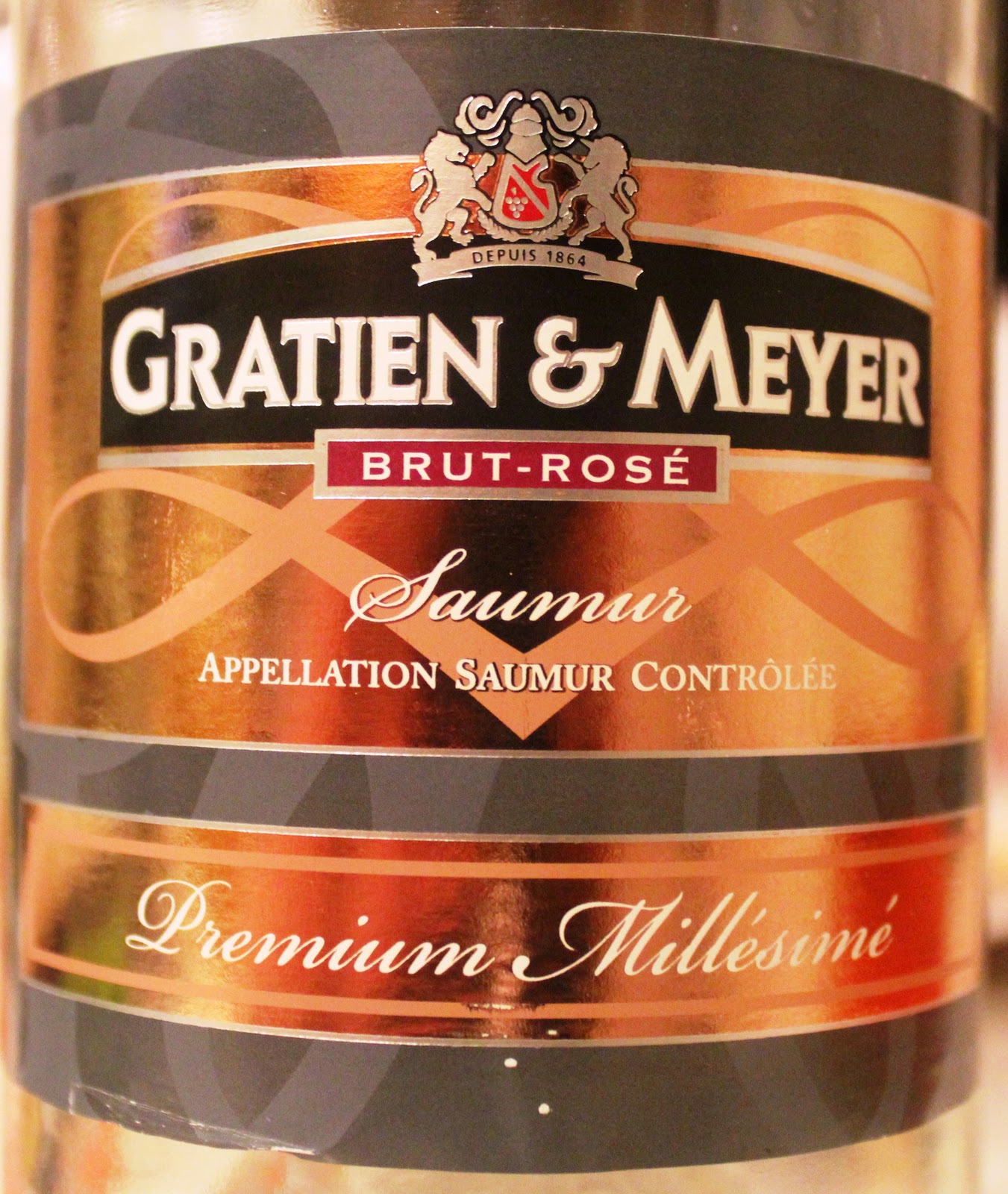
To escape the Denver heat, we enjoyed this pink French sparkler from the Loire Valley. This blend of 80% cabernet franc and 20% grolleau is extremely bubbly. It has been the only sparkler to foam out of the bottle when I've pulled the cork over the past six months. The wine is a beautiful shell pink color. I found strawberries, cranberries and flowers on the nose. Tart red fruit and bright acidity fill the mouth and it almost tastes like a very floral perfume.12% abv Purchased $17 Good
Monday, June 27, 2011
Ben's Bubbly: 2006 Gruet Winery Blanc de Blancs
As Ben nears the three month mark, his personality is getting almost as bubbly as the wine we drink in his honor. He loves interacting with us by cooing and smiling. He plays with rattles and other toys in his crib, but he really loves to show off his new motor skills to us while we watch him kick, bat and wiggle his way around the caged bed that will hold him for the next few moons. This week he also had another play date with his crew from mommy's work where he participated in his first game of soccer as a sort of opening act for the U.S.A. vs. Mexico Gold Cup championship game. He even wowed his buddy's visiting grandmother from Costa Rica with his ability and desire to stand up (with the support of mom or dad, of course). Despite his strong legs, I hope that he does not inherit his mom's early walking!
I think each of the dads had more fun than the unwitting foosball players, though the outcome of the Gold Cup could have been a bit better.
2006 Gruet Winery, Blanc de Blancs, New Mexico
 Keeping with the loose idea of trying sparkling wine from various parts of the world, this week we stayed close to home and picked a bottle from the heralded wine state of New Mexico. This wine is a pale yellow and yields beautiful streams of tiny and eager bubbles. Bright citrus flavors are met with tropical fruits, sweet green apples and a slight toasty/nuttiness. In the mouth the acidity provide a tart contrast to the flavors of apple preserves on a toasted bagel. All of the Gruet I've had in the past has been an exceptional value for the price and this vintage bottling is elegant, complex and worth trying. 12% abv Purchased $26. Very Good (tasted 7/23/11)
I think each of the dads had more fun than the unwitting foosball players, though the outcome of the Gold Cup could have been a bit better.
2006 Gruet Winery, Blanc de Blancs, New Mexico

Subscribe to:
Posts (Atom)
